Birger Sandzén: About the Artist
February 5, 1871 - June 19, 1954
Birger Sandzén born in Blidsberg, Sweden in 1871 is a renowned artist recognized as a significant painter of the Western landscape, particularly in Kansas and Colorado, during the early to mid-20th century. He is celebrated for his captivating oil paintings that depict the Kansas scenery and the majestic Colorado Rockies, along with a variety of other Western landscapes from California, Utah, New Mexico, and even Mexico. Some have referred to Sandzén as an art master.
Early years
Growing up in Sweden, Sandzén had an early interest in the arts that was supported by a home environment offering great cultural resources. At the age of ten he entered Skara School to study art under Olof Erlandson, who graduated from the Royal Swedish Academy of the Arts, and Sandzén graduated in 1890 with honors.
In 1891, Sandzén moved to Stockholm to apply to the Royal Swedish Academy of Arts, however, the waiting list was too long, and instead he joined a class taught by Anders Zorn, Richard Bergh and Per Hasseberg. This small group was later known as the Konstnärsförbundet or “The Artists' Union".
Sandzén relocates to Paris in 1894, where he starts studying under the guidance of French painter Edmond-François Aman-Jean. Aman-Jean has already achieved significant recognition, winning numerous awards in esteemed galleries across Europe, including L’École des Beaux-Arts. His studio mate is none other than the renowned pointillist painter Georges Seurat. It is in this environment that Sandzén begins to incorporate pointillism techniques into his artwork. Sandzén's early work used these techniques and the tonalist approach to color relationships.
Lindsborg, Kansas and the United States
Later that same year, Sandzén accepted a teaching position at Bethany College in Lindsborg, Kansas, beginning a long and distinguished career as an art professor and Impressionist painter in the United States.
Meanwhile, his paintings transitioned from muted tones to a vibrant post-Impressionist and expressionist style. In his later works, he employed thick applications of bold colors, utilizing a seven-color palette. Sandzén's painting style developed into broad rhythmic strokes of pure colors that "optically blend" when viewed at a distance. Sandzén began to draw inspiration from the expansive fields of Kansas. Originating from Sweden, a country known for its historic towns, cities, and rich traditions in painting, printmaking, and classical music, he often felt out of place in this unfamiliar environment. Nevertheless, the artist learned to adapt and ultimately developed a deep appreciation for the untamed beauty of the American plains.
Sandzén traveled throughout the United States and Mexico, producing some of the paintings he is most well known for. He particularly enjoyed and painted views of the rugged Southwest mountains, Bryce Canyon and Zion Canyon in Utah, Yellowstone National Park, the Grand Canyon of Arizona, the Mesa Verde National Park cliff dwellings and the Rocky Mountains in Colorado. Sandzén painted many scenes of Kansas, including family farms in Graham County, Kansas; views of homesteads along the Great Plains; and scenes of the stream and limestone rock outcroppings near Wild Horse Creek.
Although most of his paintings were in oils, Sandzén was also a talented engraver and watercolorist. His woodcuts and linoleum engravings were intended to exert a lasting effect on artists to come. On December 28, 1930, Coy Avon Seward extended an invitation to Norma Bassett Hall, Charles Capps, and seven other regional print artists to gather at Birger Sandzén’s art studio, officially founding the esteemed Prairie Print Makers. The ten artists who played a role in establishing the society that day are recognized as the charter members. The Prairie Print Makers later toured as the Mid-America Arts Alliance (MAAA), showcasing their work with support from art agencies in Arkansas, Kansas, Missouri, Nebraska, and Oklahoma. The group, which included prominent active members such as Kenneth Adams, Peter Hurd, Gustav Baumann, John Edward Costigan, and Walter Joseph Phillips, grew to become one of the largest printmaking organizations established in the early 20th century, reaching nearly 100 members at its height.
Early years
Growing up in Sweden, Sandzén had an early interest in the arts that was supported by a home environment offering great cultural resources. At the age of ten he entered Skara School to study art under Olof Erlandson, who graduated from the Royal Swedish Academy of the Arts, and Sandzén graduated in 1890 with honors.
In 1891, Sandzén moved to Stockholm to apply to the Royal Swedish Academy of Arts, however, the waiting list was too long, and instead he joined a class taught by Anders Zorn, Richard Bergh and Per Hasseberg. This small group was later known as the Konstnärsförbundet or “The Artists' Union".
Sandzén relocates to Paris in 1894, where he starts studying under the guidance of French painter Edmond-François Aman-Jean. Aman-Jean has already achieved significant recognition, winning numerous awards in esteemed galleries across Europe, including L’École des Beaux-Arts. His studio mate is none other than the renowned pointillist painter Georges Seurat. It is in this environment that Sandzén begins to incorporate pointillism techniques into his artwork. Sandzén's early work used these techniques and the tonalist approach to color relationships.
Lindsborg, Kansas and the United States
Later that same year, Sandzén accepted a teaching position at Bethany College in Lindsborg, Kansas, beginning a long and distinguished career as an art professor and Impressionist painter in the United States.
Meanwhile, his paintings transitioned from muted tones to a vibrant post-Impressionist and expressionist style. In his later works, he employed thick applications of bold colors, utilizing a seven-color palette. Sandzén's painting style developed into broad rhythmic strokes of pure colors that "optically blend" when viewed at a distance. Sandzén began to draw inspiration from the expansive fields of Kansas. Originating from Sweden, a country known for its historic towns, cities, and rich traditions in painting, printmaking, and classical music, he often felt out of place in this unfamiliar environment. Nevertheless, the artist learned to adapt and ultimately developed a deep appreciation for the untamed beauty of the American plains.
Sandzén traveled throughout the United States and Mexico, producing some of the paintings he is most well known for. He particularly enjoyed and painted views of the rugged Southwest mountains, Bryce Canyon and Zion Canyon in Utah, Yellowstone National Park, the Grand Canyon of Arizona, the Mesa Verde National Park cliff dwellings and the Rocky Mountains in Colorado. Sandzén painted many scenes of Kansas, including family farms in Graham County, Kansas; views of homesteads along the Great Plains; and scenes of the stream and limestone rock outcroppings near Wild Horse Creek.
Although most of his paintings were in oils, Sandzén was also a talented engraver and watercolorist. His woodcuts and linoleum engravings were intended to exert a lasting effect on artists to come. On December 28, 1930, Coy Avon Seward extended an invitation to Norma Bassett Hall, Charles Capps, and seven other regional print artists to gather at Birger Sandzén’s art studio, officially founding the esteemed Prairie Print Makers. The ten artists who played a role in establishing the society that day are recognized as the charter members. The Prairie Print Makers later toured as the Mid-America Arts Alliance (MAAA), showcasing their work with support from art agencies in Arkansas, Kansas, Missouri, Nebraska, and Oklahoma. The group, which included prominent active members such as Kenneth Adams, Peter Hurd, Gustav Baumann, John Edward Costigan, and Walter Joseph Phillips, grew to become one of the largest printmaking organizations established in the early 20th century, reaching nearly 100 members at its height.
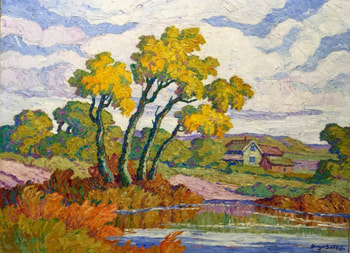
Kansas Landscape
|
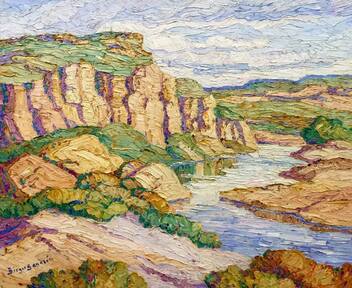
Saline Pines - Russell, KS - 1940
|
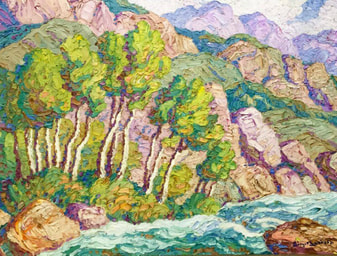
Mountain Stream, Devil's Gulch - Estes, CO - 1938
|